This chapter begins with an overview of the analysis in the preceding chapters. It then makes some predictions based on that analysis, about what is likely to happen if we continue as we are and leave too much to market forces. We shall also briefly review some of the major threats humanity faces, but which our current economic model distracts us from tackling.
All animals have to ‘produce’ goods and services to cover their needs, the ‘economy’ is the system by which they do that. The actual amount produced is limited by which of the three ingredients required for production runs out first: wants, resources, or work effort.
While past societies may have been unable to produce all the things they wanted even working flat out, or were limited by scarce resources, instead with today’s technology what mainly sets the level of production is not the availability of labour or resources, but demand, i.e. what society wants. By what ‘society wants’, we mean what society wants as whole and as currently organised. So what our current society ‘wants’ is very largely what the rich and powerful want; the needs of the poor and the powerless carry little weight. The evidence that it is a lack of wants that limits production in the modern economy, is the huge effort that goes into dreaming up new products, advertising and selling – all of it in order to persuade people to want more.
Human economies function on the basis of rules, which may be formal, custom or tradition. Fundamental among these rules is the notion of ownership, since that makes trade possible, and trade in turn allows us to compare values. Marx believed that the value of a thing depended on the work it took to make it; in practice other scarce resources such as land, can also influence value. Resources taken from the environment around us are ‘free’ because the environment isn’t a human being and asks for nothing in exchange.
Free-market economies have a ‘private sector’ of independent businesses. Consumers can choose who they buy from. Such economies decentralise economic decisions. Producers move into fields where there is more demand; consumer choice incentivises better quality and lower prices. Markets do match supply to demand but only to financial demand. The increasing complexity and variety of products means that consumers cannot easily judge quality or safety, and need regulation to protect them from potentially harmful products.
What takes place in a free market is the exchange of goods and services by a series of complicated swaps, in each of which both parties want to make the trade. Money hides the complex chains of swaps involved. A change in what one person or business wants can have a knock on effect on the rest of the economy much greater than the initial change, as can a change in resource availability. There is no ‘natural level’ of economic activity: the level of production depends on what the different actors in the economy want and may be limited by the wants of one of them to a lower level than is wanted by others.
In a free-market economy, most of us play three different roles: as workers, as consumers and as citizens. Our double lives as both workers and consumers mean that our political interests as citizens can be contradictory.
Earning a living as workers is a sort of ‘game’ in which most of us can offer only our capacity to work in exchange for the things we need. But there are some privileged players who also bring to the game their ownership of the places where goods and services are made. In return for our work in these places, they give us a proportion of what gets made in them. The rules of a free-market economy tend to concentrate wealth in a few hands
Long term change to the maximum an animal can produce results from changes in its capabilities due to evolution or, especially in the case of humans, due to learnt knowledge. Capabilities at a given moment of time are fixed: we cannot ‘decide’ to have the skills or technology of the future, although we can try to stimulate learning and innovation. Continued growth requires managing humanity’s accumulated knowledge and handing it on to the next generation. Growth as measured by GDP includes any economic activity including work to mitigate harms such as pollution.
Growth in human capabilities explains long-term growth in economic output. It doesn’t explain the cyclical behaviour of the economy, with periodic falls in output even though there is no interruption to technical progress. The three-ingredient model clarifies that booms and slumps can be expected in a market economy because positive feedback accentuates movement in either direction, and that boom peaks are not necessarily the maximum possible output level of the economy.
Connecting local economies by improved transport can weaken employment conditions in a high-wage high-technology area if it brings labour competition with a lower-wage hinterland, while at the same time result in low-tech artisans being out-competed by more automated factories. Connecting economies obliges businesses to be present in multiple markets, thus increasing transport use.
Population increase plus growth in consumption per capita, creates unsustainable pressure on the natural world. But the current market economy requires growth in order to provide jobs. There is no obvious solution to this conundrum except government regulation of some sort.
The market economy shapes the society we live in. For the worker there is an increasing impermanence in employment and in required skills. The consumer and citizen face a barrage of marketing and products, designed to maximise desire and addiction, and with little consideration given to potential physical and psychological harm.
Much that is valuable in life is out of the reach of private individuals and can only be supplied collectively as public goods. Such provision is threatened by neoclassical economic philosophy that values only individual private spending.
Some would object that our economic system has not failed but is very successful in Western Europe, the USA and Japan: poorer countries have simply failed to emulate it properly. But poorer countries are part of the global economy and have structured their economies to serve the needs of the global rich. The wealthy in poorer countries are typically not satisfied with the limited range of products their own workers can produce: they want the best the world market can provide. They therefore dedicate their nations’ economies to the production of cash crops or anything else in demand on world markets, that can be exchanged for imported luxuries. Among the imported products will inevitably also be advanced weapons systems and other instruments of control needed to maintain the privileges of governing elites in the face of extreme inequality and poverty.
Nor is it the case that the citizens of richer western countries have experienced a steady and general improvement to their lives. Among these countries you can find growing levels of inequality, failing public services, and formerly prosperous areas that have become rust-belt towns. In many cases the incomes of the working and lower middle classes have stagnated for decades.[27]
What will happen if we continue to let market forces largely determine the level of production and types of product that get made, in a grossly unequal world? Based on the analysis in the preceding chapters and on current trends, here’s what appears likely to take place in the free-market economies that participate in the global market:
Humanity is not dealing with major and urgent threats to our existence. We fail to focus on these threats, in no small measure, because we have an economic system which puts everyone from individuals to corporations to governments, under the continual pressure of competing in order to survive economically. The need to buy food today or pay the mortgage tomorrow, inevitably trump trying to tackle difficult and longer-term global problems; we cling to the hope that those problems are still a few years away and that we can delay a little longer.
Unfortunately the threats we face have never been so serious. It is no coincidence that they are happening now: it is because they are largely related to the same technological revolution that has created our modern economy and the explosion in human numbers that it has facilitated.
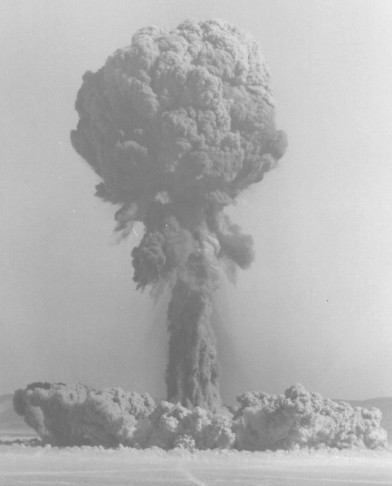
Shocked by the atomic weapons that their work had helped create, Einstein and others, founded the ‘Bulletin of the Atomic Scientists’ to warn of threats to humanity.[28] The Bulletin continues to inform; it maintains a doomsday clock to visualise how close we are to apocalypse:
The Doomsday Clock is set every year by the Bulletin’s Science and Security Board in consultation with its Board of Sponsors, which includes 11 Nobel laureates. The Clock has become a universally recognised indicator of the world’s vulnerability to catastrophe from nuclear weapons, climate change, and disruptive technologies in other domains.
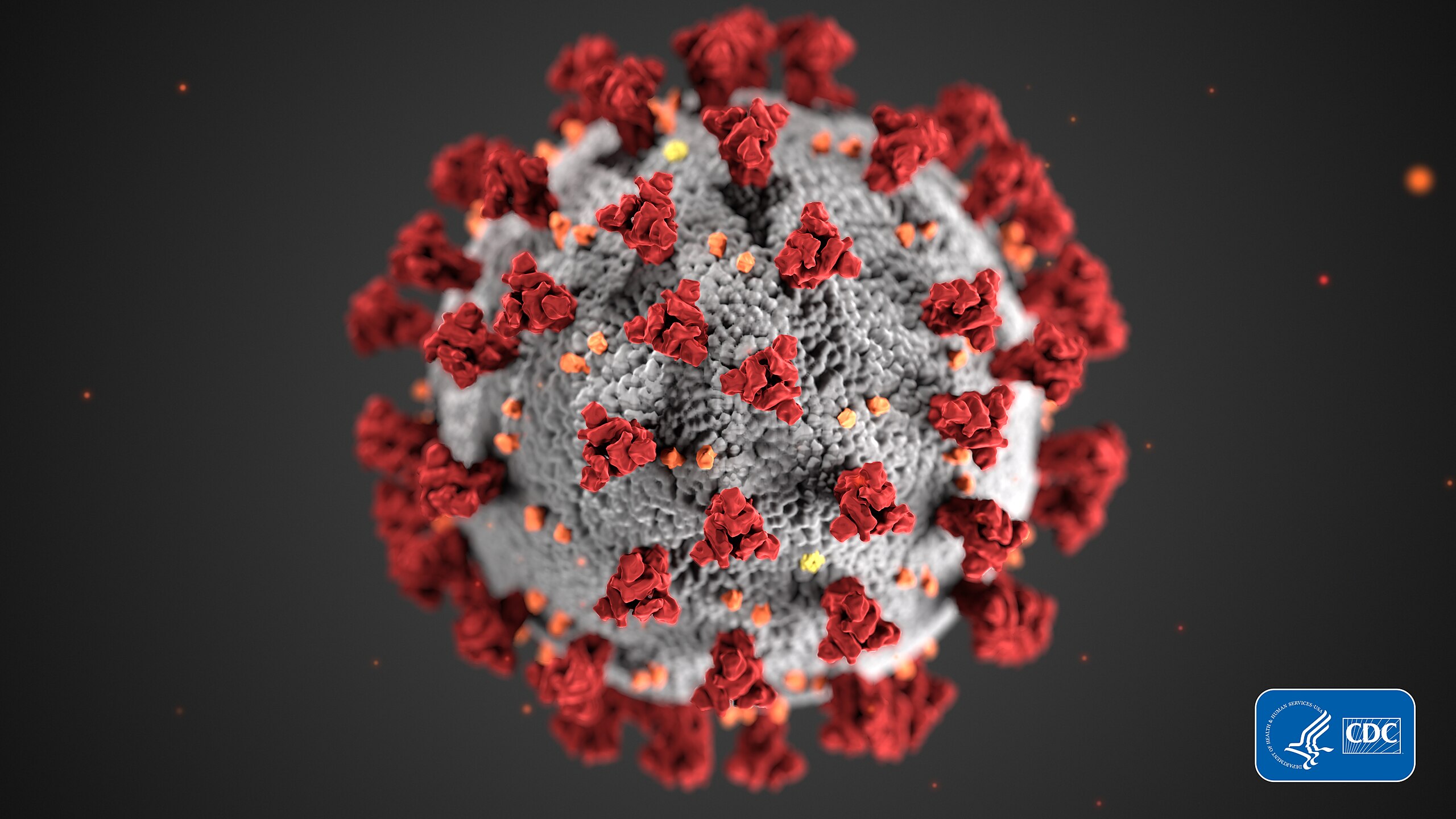
Other groups of scientists make similar assessments. In the UK, the ‘Centre for the Study of Existential Risk’ is an “interdisciplinary research centre within the University of Cambridge dedicated to the study and mitigation of risks that could lead to human extinction or civilizational collapse”.[29] In an article written for the BBC published in February 2019, scientists at the centre put the most probable risk for 2019 as a “severe pandemic such as flu”.[30] The COVID-19 pandemic started later that year, being first reported in December.
Some people argue that although there are risks on the horizon, humanity has in fact never had it so good. Harvard professor Steven Pinker might be considered by some to give support to this view in his books ‘The Better Angels of Our Nature: Why Violence Has Declined’ and ‘Enlightenment Now: The Case for Reason, Science, Humanism, and Progress’.[31, 32] He points out that life has been getting better for most people based on a variety of statistics, including that people are living longer and healthier lives, and are less likely to be murdered or die in conflict. However, while the statistics are fascinating, it is plain that we should temper such optimism with concern for what is currently happening in the physical world around us, even if the impacts of forces such as climate change don’t yet seem too severe. Reason also tells us not to ignore potentially devastating risks such as all-out nuclear war, merely because so far we have been lucky.
Should the crew on an ocean liner study the horizon for icebergs, or study statistics about how ocean travel is becoming safer?
Professor Pinker’s work highlights the sorts of factors that may have led to past reductions in violence. We have the opportunity to learn from such research what sort of behaviours and institutions we should support and promote in the future.
A further reason to be careful about extrapolating favourable statistics into the future is that a collapse often follows a peak. This is discussed in ‘Collapse: How Societies Choose to Fail or Survive’ by Jared Diamond.[33] The book is mainly concerned with the demise of historical civilizations, but Diamond also argues that humanity faces many of the same issues, with possibly catastrophic future consequences.
If you consume a food store meant to last you a month in just two weeks, life seems pretty good during those first two weeks.
Scientists have warned of the threat of climate change for over thirty years with increasing alarm.[34] Global heating is causing droughts as rains fail, rivers dry up, and glaciers that once fed rivers melt. Crops fail directly because of drought or because they are not adapted to the new extreme temperatures. Extreme weather also threatens our infrastructure: electricity, water supplies and transport. Unfortunately market forces do not provide adequate incentives to stop the activities that cause the damage or to prepare for changes that are seen as being in the ‘distant’ future.
Apart from direct threats to humanity, there is the destruction of the natural world. Scientists believe that during our geological epoch the Holocene, which started about 10,000 BC, other species are disappearing due to human activity at somewhere between a hundred and a thousand times the normal rate. That puts us at the centre of a ‘mass extinction’ event, like the one that wiped out the dinosaurs.[35] Since we are totally dependent on nature for oxygen and food, if we destroy too much then we will also become extinct. Even if we stop short of that and humanity or some fraction of it manages to survive, they will be living in a largely barren world, devoid of the natural beauty of the wild animals and plants we have hitherto lived alongside.
Awareness of these issues is growing, but effective action lags far behind because the logic of our economic system prioritises making money in the market and financial survival, over all else.
The free-market economy has failed to provide a reasonable standard of living worldwide because it cannot generate enough demand or ‘wants’ to create full employment. The poor have many things that they want and indeed need, but an economy based solely or mainly on private enterprise and markets recognises only the wants of those who possess something tradable to offer in exchange – in other words, only monetary demand is recognised. When the rich spend less than their income because they have satisfied most of their wants, then the economy slows.
Attempting to maintain employment through growth is a failing strategy. The advance of automation puts a downward pressure on employment. The weak position of global labour with employers moving jobs to the lowest-wage areas, likewise subdues potential demand for goods from workers and therefore employment levels.
Nevertheless, to induce those with money to spend, much of the economy is focussed on generating endless growth in things to want and consume, pushed at the public by intensive advertising. This is a poor way to provide employment as high consumption damages the environment and many of the products are of no benefit to humanity and often do harm.
The intense competition in the market economy shapes the society we live in. For the worker there is increasing impermanence, and for the consumer, a barrage of marketing designed to maximise desire for products even if they are harmful. For citizens and politicians, short-term economic prosperity outweighs facing up to long-term dangers.
Consuming our way into full employment is not an option. Humanity already faces existential threats due to the current level of consumption and growth in population. While most of the environmental damage is caused by the wealthiest consumers, the aspiration to consume at these levels reaches far beyond them. Extending the existing consumption levels of the world’s middle classes to everyone worldwide, is incompatible with retaining any chance of preserving a habitable planet.
So our economic system, while associated with an astonishing pace of technical advance, is flawed – especially so in terms of social justice and sustaining the environment. In Part Two we will consider what we might do to tackle the flaws.