Most of us play multiple roles in the economy. As described in Chapter 6, we are workers who must sell our labour to earn a living, we are lady or gentlemen consumers who employ people to work for us through the goods and services we pay for, and we are citizens who have the potential to change society’s rules.
The economy shapes our experiences in these roles in different ways. As workers, we may have long, tough and stressful working days. But when we leave work and become consumers, the boot is on the other foot: we can shout at the waiter or other service staff; we can shop for the cheapest ‘best-value’ products – thus employing the industrial and agricultural workers who make them for long hours at low pay. Whether or not we play full roles as citizens depends upon whether the economy allows us the time and space to form stable communities within which our voices can be heard, and upon what access we have to the levers of power.
Free-market economists promote the idea that if each individual pursues his or her self-interest, he or she will indirectly promote the good of society. Society’s highest and overriding goal should therefore be promoting self-interested competition in a free market. However, while the market does provide an incentive to produce attractive products at reasonable prices, that is far from enough to ensure the good of society, because:
Most adults of working age need to find a job in order to earn a living. Once independent of their parents they acquire financial responsibilities that require a regular wage to cover them: supporting a family, rent or a mortgage, utility bills, hire-purchase payments for expensive items, and so forth. If the regular wage ceases, the life they have built up can quickly unfold. However, after the Second World War, there was a period in the UK and many other western nations during which a shortage of workers plus strong trades unions, combined to provide long-term job security to many workers.
But today that security is missing because it is the level of ‘wants’ that now limits the economy, there is unused work effort and the bargaining position of workers is weakened. As a result, increasing numbers are employed in the gig economy where there is no certainty of employment from day to day. Even if you do have a ‘permanent’ job, the modern economy is changing so rapidly that there is little likelihood of it being a job for life. Working lives are characterised by constant impermanence and insecurity, which make it harder to settle in a location or to take on responsibilities or hobbies that require continuity. The frequent need to move to a new job may mean uprooting the whole family, affecting their sense of place and belonging. Poor quality jobs are usually also poorly paid, meaning that even if employed, the worker may live in poverty or scraping by at what UK politicians have taken to referring to as the ‘just about managing level’.1
The market economy’s inbuilt drive to reduce labour costs, puts businesses under pressure to pay the least they can and extract long working hours in return. Keeping costs low also means minimising spending on health and safety at work. Workplaces have not historically been especially safe places – jobs were often physically wearing with long hours, unhealthy conditions and danger of injury; some still are. To these we can add the more modern risks of unhealthy shift patterns, long periods sitting or standing, and lack of exercise.
As well as physical effects, there are psychological effects. Computers have provided employers with the ability to micro-manage their workers and monitor their every movement: a level of control that makes bullying and coercion easy, and removes the worker’s freedom to choose how to carry out a task. Mobile phones and email mean that employers can contact employees at any time of the day or night, and during weekends and holidays.
Minimising labour costs entails breaking down tasks into simple ones that can be carried out by unskilled staff with a minimum of training. This also makes it easier to monitor the workforce and measure their output. The downside for the worker is dull, repetitive work and a weak negotiating position – you are easily replaced. With no shortage of workers to choose from, employers are reluctant to train, limiting opportunities for individuals to upskill.
Another way to keep labour costs down is to hire on a short term basis, paying just for the hours worked. This was common practice in the past for many manual jobs: dockers used to queue at the dock gates each morning and the companies took only the men they needed that day. Trade unions fought against the practice and for legislation to enforce employment contracts providing benefits such as holiday and sick pay. However, in recent years, business has sidestepped such laws by outsourcing: they pay an external company to provide them with casual workers instead of paying the workers themselves. The external company can be an agency that provides no guarantee of employment and only casual work to people on their books – the so called ‘gig economy’.
Businesses should not necessarily be condemned for seeking to maximise output per worker and minimise costs, because in a market economy they have little choice: it’s that or risk being undercut by competitors in which case they would go out of business and their employees would all lose their jobs. Nor does getting the best out of the workforce always involve poor working conditions. Good working conditions and adequate pay may result in higher productivity that more than compensates for the extra costs, especially when the task is complex and highly skilled, and in areas where it is hard to measure the quality of the work in a simple objective manner meaning that employers have to rely on the judgement and professionalism of their staff. By contrast, low-skilled jobs and jobs where the output is easily measured, are more vulnerable.
To flesh this out, here are two examples of jobs, the first being one in which it’s in the employer’s interest to treat the employee well, and the second where the employer has little incentive to do so:
Throughout history up to the outset of the industrial revolution some 200 years ago, most work was related to production of goods and services that can be seen as the necessities of life: food, clothing, housing, and so forth. Added to that would be whatever was required by the church, monarch and armed forces. Most people had professions which would be familiar to their peers. Here are the kinds of jobs you would find in a town in 15th century Europe:
Medieval Jobs:
Butcher, Baker, Stonemason, Weaver, Winemaker, Mason, Farmer,
Watchman, Shoemaker or Cobbler, Wheelwright, Roofer, Locksmith,
Tanner, Tax Collector, Belt maker, Grocer, Merchant, Armourer, Carpenter,
Cook, Blacksmith.[20]
Even today, most people continue to recognise those trades and understand their purpose. Contrast those jobs from the Middle Ages with the extraordinary number of esoteric professions encountered today. Many of us have job titles that are meaningless to most of our compatriots. Even if the job title is one you’ve heard of or gives a clue to the sector, what that person actually does is still often obscure to anyone except those who work in the field. Here are a few modern job titles – do try your hand at imagining how they spend a typical working day:
21st Century Jobs:
Project Owner – Retail, Senior Procurement Category Manager, Duty
Engineer – Terminals, Chemical Engineer, Compliance Monitoring
Officer, Binder Broker, Financial Crime Associate, Python Software
Engineer, Mulesoft Developer, Medical Affairs Manager – Rare Oncology,
Microblading Tutor, Fragrance and Beauty Sales Consultant, Emergency
Planning and Business Continuity Officer, Embedded Software Engineer,
Simulink Code Generation Engineer, Algorithms Engineer, Arable
Operator, Assistant Growing Manager, Digital Marketing and SEO
Specialist, ASIC Design Engineer, Customer Experience Specialist,
Scrum Master, Cyber Operations Specialist, Geospatial Engineer,
Horizontal Construction Engineer, Diagnostic Medical Sonographer, Web
Developer.
Technological development inevitably grows the number of specialist professions, whatever the economic system. It is to be expected that you may find yourself in a job that is obscure to others, hard to explain even to your family and definitely not a subject for small talk at parties. Technology allows the creation of bigger and more complex systems in which many jobs represent just a small part of the process, making it harder to feel part of an overall objective rather than just a cog in the machine.
However, our modern want-driven economy can make such feelings of alienation worse if the objective of a job feels pointless because the product is one of the unnecessary and wasteful products or services generated by the pressure to create more and more ‘wants’. In cases where the product is harmful to society or the environment, employees may have to struggle with their consciences if are aware of the harm caused yet need the job too much to leave it. Workers, their trade unions and local politicians, can end up defending damaging industries because they provide jobs; examples are the fossil-fuel industries, nuclear power, weapons of mass destruction, junk food, tobacco, gambling.
The free-market economy has an in-built drive to continually persuade people to want a bigger variety of things and more of them. The resulting steady increase in the demand for products has sustained a level of employment that would otherwise have fallen due to automation. In recent years, the level of production does not appear to be much limited by resource shortages (despite how rapidly some are being used up), or work-effort, but by a ‘want’ shortage – there are not enough things for the rich to desire sufficiently to get them to spend their money. Accordingly, much of current economic activity is devoted to inflating society’s desires: dreaming up new things to want and intensively marketing what already exists.
What gets made affects the nature of society. In the past when human productivity was far lower, what got made could be more reasonably seen as the result of consumer choice because most consumption would be for the basic human needs – food, clothing, shelter. But many products in today’s economy are dreamt up by corporations whose only motivation is to generate more and more ‘wants’. To what extent are consumers really making independent choices, as opposed to finding themselves more akin to putty in the hands of the corporations?
An economy devoted to inflating society’s desires - “driving us crazy with desire” - might sound rather exciting, until you realise that the desires promoted are for one brand of washing powder instead of another, for a sugary fizzy drink or a plastic sports shoe.
To extract the most profit from the market, companies want to mark up the price of a product as much as possible (i.e. sell it for much more than it cost to make) and sell it in large numbers. There is a trade-off between the two: for example if you try to sell too many, the price you can charge may fall, and you could actually end up earning less. Thus, the advertising industry is dedicated to making you desire a product so much:
Businesses seek out all possible opportunities to encourage the consumer to spend. They build huge shiny shopping malls. They use every means invented to get at the consumer day and night, subjecting us to a barrage of propaganda: paper mailings, billboards, illuminated digital billboards, adverts on the sides of buses, on stations, in the metro, in sports stadiums, on sports and celebrity clothing, radio adverts, TV adverts, cinema adverts, adverts in smartphone apps, on websites, via social media and email, in newspapers and magazines. They target the vulnerable: films for kids with associated branded merchandise; junk food with excess salt, sugar and fat, in packaging decorated with characters from TV and film; supermarket shelves full of these tempting products placed at head height of the targeted kids.
But it’s not just the advertising industry trying to drive us crazy; it’s a very large part of the global economy which produces less than it could because our society doesn’t ‘want’ any more: it has run out of wants/desires. Of course there are lots of people who do desperately want things out of genuine need and may even be going hungry, but they don’t count since they produce no ‘demand’ in the economy if they haven’t got money. The people who could produce demand are the more wealthy who have money piled up in their bank accounts and can’t think of anything that they want to spend it on. Accordingly, companies are motivated to dream up more and more products in order to tempt the wealthy to part with their cash. The result is an avalanche of products and services, some of which are genuinely useful, interesting or fun, while others reach levels of ludicrousness or pointlessness that can be hard to believe. Among the latter are wristwatches that cost thousands or even millions of dollars. A quick search in-line found one such for $38,000 which offers “Day, Date and Moon Phase”, all of which I found to be available on a $45 watch and in smartphone apps that are free.
While the rich have the most to spend, the poorer part of society is not completely ignored, with shops full of countless cheap knick-knacks (small worthless objects) which might tempt those with only a few dollars to spare. Betting shops and slot machines are common even in run-down suburbs.
Unless constrained by law, advertisers and the creators of new products dedicate themselves to exploring and probing every human weakness in order to tempt consumers to buy, without any regard to the damage that may be caused to the customer, society, or the environment.
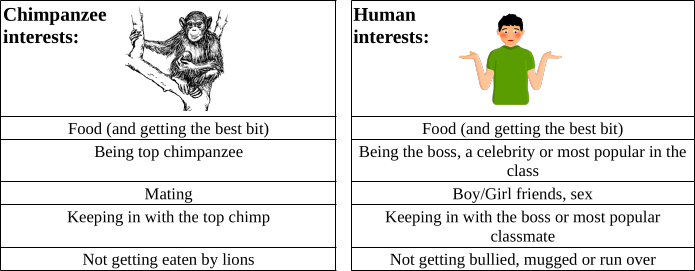
Plants and animals have evolved to explore and take advantage of every nook and cranny of our planet. In the same way, businesses in the market seek out every way that we can be tempted to buy. There are markets of the most rarefied sort for products that appeal only to small subsets of society. For mass markets however, we need to appeal to the desires most of us share. What are these desires shared by most humans? They are not so very different from those of other higher animals. A chimpanzee’s interests probably include something like:
Since humans are chimpanzees’ closest relatives, we unsurprisingly have some rather similar interests, as shown in Figure 14.1.
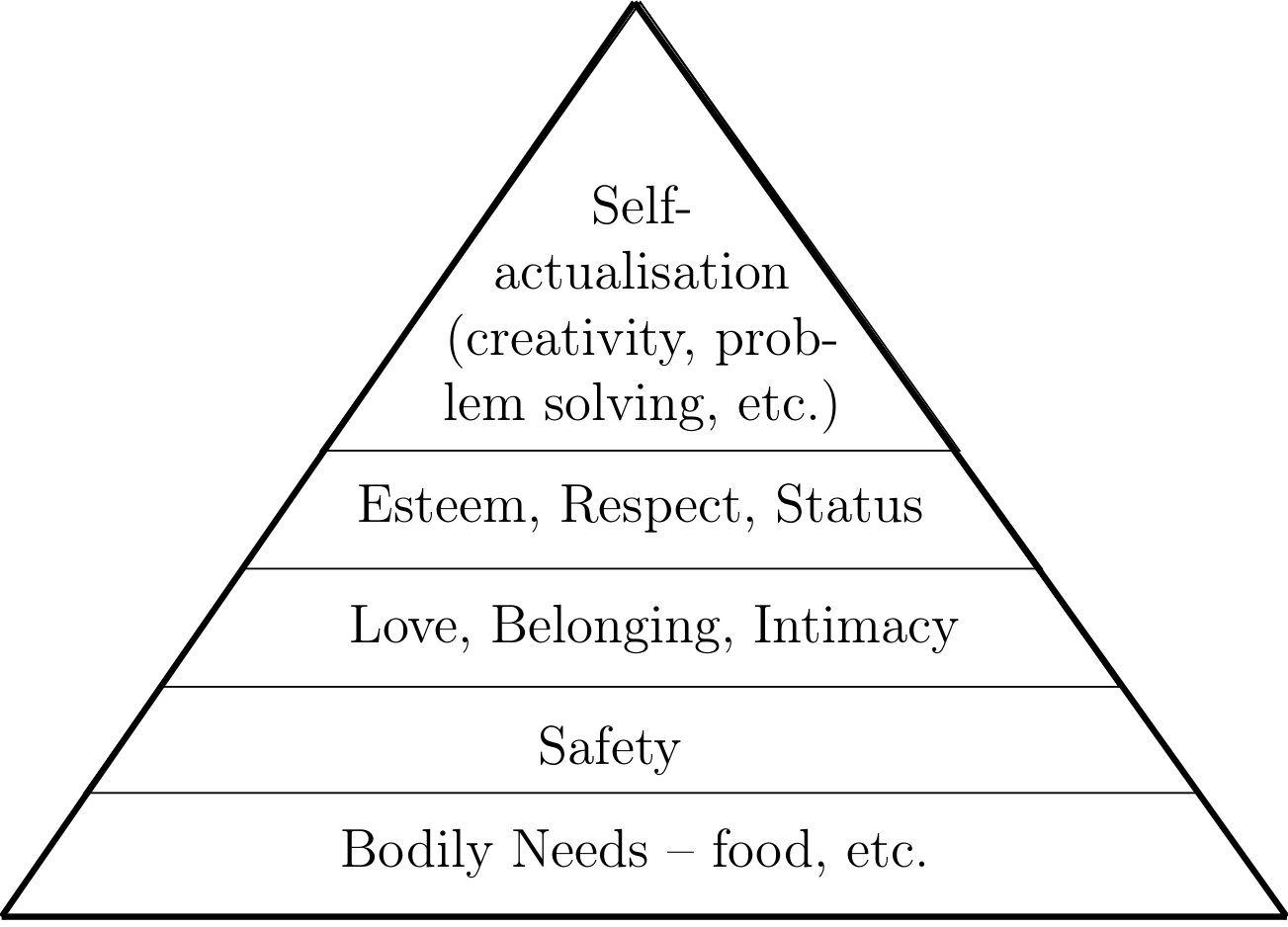
If comparing us to chimps isn’t to your taste, you could refer to the five-tier model of human needs known after its originator as Maslow’s hierarchy of needs, typically set out as shown in Figure 14.1.3 Although phrased differently, the overall picture isn’t that different.
To sell products, the market explores all of the human needs that it can, stimulates them to the maximum and exploits them to the full. All profitable segments of the market get attention, so minority interests are catered for including ‘refined’ tastes in the high arts. But mass marketing goes for the guts, the basic drives we all share – everybody has a stomach!
Humans evolved to like sweet things – fruit is sweet when it is ripe
and best to eat. Before we became Homo sapiens and throughout most
of human history, we didn’t have the means to extract refined sugar
from cane or beet. Therefore, evolution did not weed out the desire to
consume huge quantities of sugar because it didn’t need to, since
nobody could. There is a lot of money made out of that sweet tooth.
The purveyor of a famous fizzy sugary drink uses phrases like these in
their advertising:
Delicious and refreshing, revives and sustains, life tastes good, make it
real, love it light, open happiness, twist the cap to refreshment, life begins
here.
The UK’s National Health Service budget in 2011 for ‘targeting
improvements to the lives of young people’ was £4 million (about $6.4
million), and had to cover a whole range of health issues, not just
sugar-loaded drinks.[21] That year the famous fizzy drink manufacturer
had an advertising budget that has been estimated at about
$3.25 billion.[22] Here are some rather more informative phrases about
sugary drinks – but you are unlikely to see these in any advert, as there
isn’t any money to be made advising people NOT to consume
something:
Sugar causes tooth decay. Foods with added sugars contain lots of calories, but often have few other nutrients. Eating these foods often, can contribute to you becoming overweight. Being overweight can increase your risk of health conditions such as heart disease and type 2 diabetes.
While we have evolved to be aware of obvious physical threats (by natural selection favouring those who handled them more effectively), evolution takes place over very long time periods. So it is not just refined sugar that is too recent a thing for us to have evolved to use judiciously, but a host of products and practices.
Our hunter-gatherer ancestors were obliged to exercise if they wanted to eat, or go anywhere; in fact, until the 20th century, most humans continued to travel only or mainly by walking. So there was no need to evolve a desire to exercise just for the sake of it. But now, cars and supermarkets allow modern humans to be almost entirely sedentary. Similarly, we evolved psychologically to have a sophisticated social ability – but it evolved to deal with the few people in sight or earshot of us, not with continual communication from potentially hundreds of people via social media.
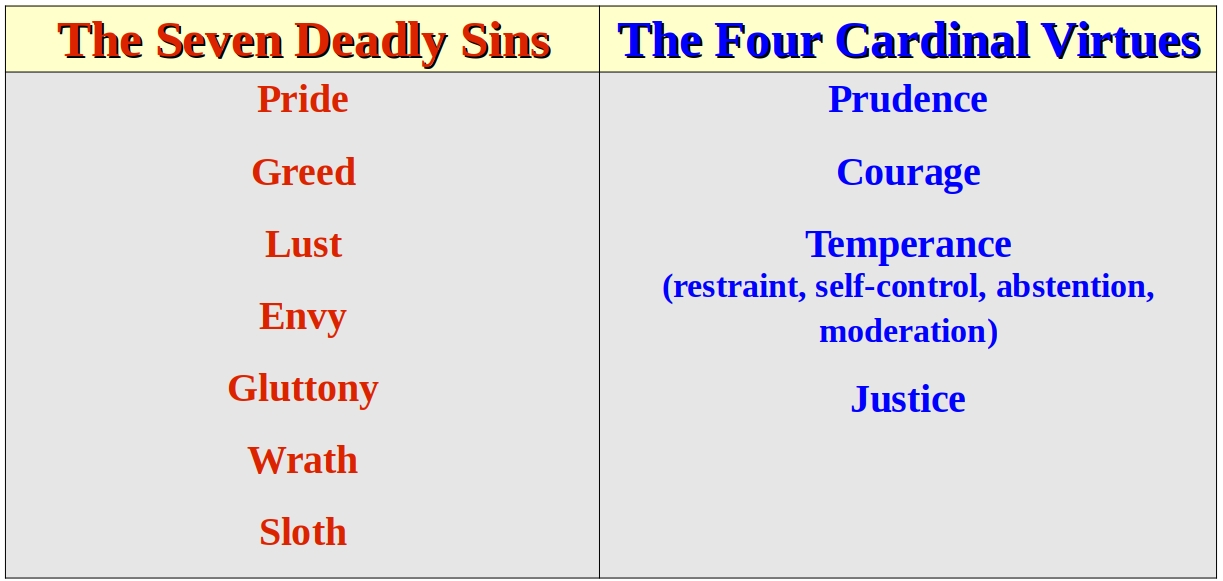
Traditional teachings show a long-standing awareness of human weaknesses and the wisdom of moderation in one’s wants. Of the human weaknesses available to exploit, just consider the ‘seven deadly sins’ described in Christian teachings: pride, greed, lust, envy, gluttony, wrath and sloth. It’s pretty easy to see how you could sell a product that appealed to one or more of those ‘sins’. So what about marketing things that appeal to our virtues? Four ‘cardinal virtues’ were recognised in classical antiquity and in Christian teaching: Prudence, Courage, Temperance, Justice. No doubt there are products sold that support those virtues, but you can see it might harder: ‘Temperance’ is the practice of restraint, self-control, abstention and moderation ... scarcely qualities you want in your customers, they might never buy a thing.
What it boils down to is that while philosophers and religions throughout the ages have concluded that wisdom and moderation are the keys to a good life, it is unfortunately the case that these qualities are quite the opposite of what you want to promote if you want to sell shedloads of stuff. An amusing summary of the good life is given at the end of the Monty Python comic film The Meaning of Life: “Try to be nice to people, avoid eating fat, read a good book every now and then, get some walking in, and try and live together in peace and harmony with people of all creeds and nations” Certainly not a great sales opportunity is it: a few books and a pair of walking boots!
A book that examined the marketing machine and became a classic of its time, is ‘The Hidden Persuaders’ by Vance Packard(1957).[23]
In making us want more, the market is unwilling to leave any stone unturned. Medieval society placed many restraints on commerce: through religion, deference to authority and custom. These have been slowly eaten away because modern capitalism tries to remove any obstacles to making money.
When I was a child there were strict Sunday trading laws in the UK which required most shops to stay closed on Sundays, allowing only newsagents to open, and then only for the sale of Sunday papers and a limited range of goods. I once tried to buy a battery for a toy and was turned away because a battery is non-perishable and could have been bought on a weekday. Shop hours were usually 9am to 5.30pm, sometimes closing for an hour at lunchtime. Wednesday or Thursday, depending on the town, was ‘early closing day’ when the shops closed in the afternoon to give the shopkeepers a half-day rest mid-week. Working on a Sunday was frowned on as sinful. Pubs had limited opening hours and in Wales were closed entirely on Sunday. After midnight in most towns and cities, nothing remained open. Most of these restrictions would astonish a young Briton today. Nowadays, people are proud of ‘cities that never sleep’.
My impression is that most of these changes have come about by businesses pressing for more opportunities to sell, although I accept that among a public educated over many years in consumerism, many of these measures are popular – and like everyone else, I’ve become accustomed to the shops being open seven days a week. But why did our ancestors evolve the rule of not working on Sundays? Was it just religious observance, or was there wisdom, channelled via that religious stricture: that it is good for workers to be guaranteed a day of rest and for society to have a day of relative peace and quiet? If that was the motive of the ‘Sundays Closed’ rule, the fact that some of us can be tempted to shop on a Sunday or even like it, doesn’t necessarily negate the wisdom of the former practice. After all, the whole point of wise advice is that it works out better in the long run than following your immediate inclination would do.
The continual and accelerating change that is characteristic of our modern economy is very eloquently described by Marx and Engels in a passage I shall quote below. They were however, very focussed on the owners of industry or ‘capitalist class’ which they refer to as the ‘bourgeoisie’, and unfortunately that leaves the reader with the impression that the whole system has been dreamt up and is managed by these ‘bourgeois’ schemers. I believe that we are better off understanding the creation of free-market capitalism in terms of social evolution: capitalism was not the result of a plot by a few people or a class, but the outcome of the actions of numerous people who were merely following their own interests. In the process some people ended up as capitalist owners (or ‘bourgeois’) and some as workers. Lions and zebras have a shared mammalian ancestor, but there was no lion ancestor who planned a future in which his or her descendents would eat zebras; evolution brought that about, without planning by any lion ... or for that matter by any zebra. In fact Marx argued that the technology that a society is based on determines the type of social structure that it has, i.e. the ‘bourgeoisie’ are the creation of the economic system rather than the other way around. Accordingly, I have slightly edited the passage quoted below to replace references to the ‘bourgeoisie’ (retained in parentheses) with references to the free-market or business (in bold), which makes it into a very effective description of today’s economy:
“The unconstrained free-market (bourgeoisie) cannot exist without constantly revolutionising the instruments of production, and thereby the relations of production, and with them the whole relations of society. Conservation of the old modes of production in unaltered form, was, on the contrary, the first condition of existence for all earlier industrial classes. Constant revolutionising of production, uninterrupted disturbance of all social conditions, everlasting uncertainty and agitation distinguish the free-market (bourgeois) epoch from all earlier ones. All fixed, fast-frozen relations, with their train of ancient and venerable prejudices and opinions, are swept away, all new-formed ones become antiquated before they can ossify. All that is solid melts into air, all that is holy is profaned, and man is at last compelled to face with sober senses his real conditions of life, and his relations with his kind.”
“The need of a constantly expanding market for its products chases business (the bourgeoisie) over the entire surface of the globe. It must nestle everywhere, settle everywhere, establish connexions everywhere.” – The Communist Manifesto, with author’s aforementioned edits.
Our working lives in the modern economy suffer from impermanence – frequent changes of job and the need to move or migrate in search of work. That impermanence, combined with the intrusion of work via long hours and continuous communication interrupting what was formerly free time, make it difficult to participate in community life – involvement in things like churches, social groups, sport, pastimes & hobbies, political parties and unions. Job changes make it harder to live close to family and friends, and affect the whole family if a spouse and children are also obliged to move.
The very rich are inevitably tempted to run the world in their own interests. Wealth, like power, corrupts: if you are fabulously wealthy then it’s very easy and convenient to believe that it is because you are special and therefore deserve privilege and political influence. The public are fascinated by those who build large fortunes thorough ‘clever’ investing or a successful business idea, often seeing them as sages or gurus, and pouring over their biographies for clues to their success. But are people who build up large fortunes, cleverer or wiser than the rest of us? We should beware of assuming so because:
They may have just got lucky
A key element to their business success will often be simply that they tried; entrepreneurs are after all often referred to as ‘risk-takers’. But the problem with trying to emulate successful risk-takers is that we are forgetting how many took similar risks and failed. I recall reading about a brave soldier who won a medal by running across a battlefield under fire to capture an enemy dug out. I imagine that such a man is well aware of his luck and conscious that other soldiers have taken similar risks and been killed. Many risk-taking entrepreneurs simply lose their money (or someone else’s). The successful ones are not necessarily sages – they may just have got lucky.
Money and enrichment may be their main or sole focus
One reason that people get rich is that they have devoted themselves to making money. Most of us want to have enough, but beyond that other interests take over, such as family life. And those of us who do devote a great part of their life to work, are often not motivated primarily by money, but have a vocation; they are passionate about something, be it art, theatre, teaching children, caring for the sick, scientific research, protecting wildlife, or something else. Such vocations may earn you an adequate living (though sometimes not even that), but don’t usually make you into a billionaire. So we have to ask ourselves, would we rather have an ex-teacher who isn’t rich but understands schools, as minister of education, ... or someone who got lucky in business or spent their career in banking extracting as many millions in bonuses as they can?
Organised pressure and lobbying comes from those with the money to do it, which means from the very rich and from corporations (often of course these overlap as those owning or running corporations are likely to be among the very rich). They are able to directly fund and lobby politicians and also build public support via the newspapers, websites, TV & radio stations that they own. This means that the corporations and the wealthy, are not only able to dominate any debate – they can also largely set the agenda of what gets debated in the first place. Causes that are of no interest to the wealthy or to corporate interests, must rely on forming campaigning organisations or political parties and then raising what they can from non-wealthy individuals who by definition have less to give, or from the occasional rich benefactor who sympathises.
Data on the funding of newspapers, websites, TV & radio stations, lobbyists and political parties, readily show how many are owned or financed by billionaires. Many of those media outlets maintain a continuous campaign of vilification against social organisations they see as a threat to the business interests of their backers; their targets include public-service broadcasters (like the UK’s BBC), trades unions, opposition parties, and the green movement. In some parts of the world this extends beyond vilification, to murder: twenty-seven land and environmental activists were murdered in 2020 – the highest number ever recorded for a second consecutive year.[24]
The drive to seek out more areas where the market can operate and make a profit, puts public property and the world’s commons, under threat.
Funding for the public sector is dependent on the economy. So a global ‘race to the bottom’ via unfettered competition makes it a struggle to develop and maintain schools, hospitals, libraries, parks, etc.
The world’s commons and public spaces – the air, the oceans, the Antarctic, outer space – are all eyed up as the next exploitable resource. The public will be seduced with promises of jobs and wealth but will end up with a degraded planet and empty pockets.
Should societies and governments have a purpose, in the sense of a goal that they strive for? Have they done so in the past? For example, motivating themselves in the cause of:
Some consider that modern free-market societies do not need and should not have any collective overall sense of direction. Instead, the individual should be sacrosanct and the only purpose of government is to create the conditions in which individuals can find their own fulfilment. But individual citizens are too disparate and isolated to be able to influence policy on a day-to-day basis. Such influence as they have, and then only in democracies, is limited to the rather blunt instrument of being allowed a vote every few years to choose between a small number of political-party slates, that are marketed to them in an election.
It can be argued that citizens get to choose the direction of the economy by their purchases, but they can only do that as individuals or to a limited extent via clubs, societies and charities that they support. They don’t participate in decisions about where the serious money goes. That is decided by national government, corporations and the very rich.
So what does set the direction of society? Corporations and the very rich are forever on the lookout for new things to market. As technological development throws up new possibilities, they seize on every new product opportunity regardless of any consideration of its effect on society, the sole consideration being whether they can sell it at a profit. They and their owners lobby government to remove controls and regulations that limit what they can sell. Where controls continue or are strengthened, it is often only because of overwhelming evidence and a tooth-and-nail fight against corporate interests, such as in the case of tobacco.
So for example fizzy & energy drinks, junk food, alcopops, addictive or violent video games, and addictive social media platforms that allow on-line abuse, all exist not because after careful consideration society thought we could benefit from them, but simply because there’s money to be made and no law against them. Only when the damage is done and the negative effects appear does society struggle to catch up and consider some sort of regulation or limit, but then lawmakers have not only to face down the suppliers of the product, but also deal with the generation of addicts that has been created.
Where are the risk assessments? In the UK as no doubt in many other countries, ‘risk assessments’ are often requested for activities that are fairly innocuous – taking children on certain types of school trip for example. Some may regard this as ‘health and safety gone mad’ and others as a sensible precaution. But what is really astonishing is that while a risk assessment may be considered necessary for a school outing, no such risk assessment was required for introducing into the bedrooms of the nation’s children, equipment that gives them access to extreme violence and inappropriate imagery, and bombards them with advertising, misinformation and conspiracy theories. While any adults helping in a school or on a school trip who may be alone with children, will be required to have a criminal record check,4 the tech companies have provided unsupervised access to our children by random and often anonymous adults from anywhere in the world, without any checks on their identity whatsoever, let alone a criminal record check.
For more about the effects of the smartphone and internet access on children’s mental health, see the work of US social psychologist Jonathan Haidt who has a book on the subject: The Anxious Generation.[25] Smartphones however, are merely one example. There are a host of products that are marketed at children and adults that are a threat to physical and mental health, and that have never had to go through the risk assessments that are imposed on bodies like schools – a bizarre situation given that schools are far more likely to care for children than are private companies seeking only to make a profit from them. The avalanche of new products constitutes a vast experiment with the mental and physical well-being of the population, which we are carrying out blindly.
An Alternative? Surprisingly few societies have seriously proposed a goal other than maximising the amount of cash we make out of each other. However, Bhutan – a small, landlocked country in South Asia – has adopted a philosophy of promoting Gross National Happiness over GDP (Gross Domestic Product).[26] Surely the rest of the world ought to be capable of finding an alternative to the current GDP obsession of most countries with its destructive tendency to maximise the amount of garbage produced?
The goal adopted by the modern free-market economy is ‘produce and sell more stuff’. This goal overrides responsibilities to provide decent jobs and livelihoods, protect the environment, and promote the happiness, health and fulfilment of the population. An uncontrolled market actually incentivises low levels of employment, low pay, wanton consumerism and damage to the environment. It also leads to gross inequalities and unwarranted interference in public life by the very rich in pursuit of their interests.
Free-market purists will argue that it is no business of the state to promote goals such as decent jobs, the environment, happiness, health and fulfilment, which should all be left to individuals and consumer choice. But isolated individuals subject to a barrage of advertising, are in no position to achieve those goals, which require social action not individual action. As a result it is unfettered corporate interests and the wealthy, who primarily set the direction of society.
Collective action is required to achieve those other goals. There is no reason why society cannot have a collective view as well as an individual one – indeed, multiple collective views, as the state need not and ideally should not be the only actor. The free market can be a valuable tool, but governed and controlled by broader human values.
1A ‘just managing’ family has been defined as one that is in the lower half of the income distribution.
2The 2019 film ‘Sorry We Missed You’ directed by Ken Loach, is based on the conditions of employment of such drivers.
3Originally described by American psychologist Abraham Maslow in a 1943 paper.
4In the UK, a DBS check – Disclosure and Barring Service.