All animals have an effect on the environment, but humans are having such a dramatic and catastrophic impact that scientists have suggested that we are in a new geological epoch: the ‘Anthropocene’.[13] This impact is a result of our growing capabilities due to advances in technology, which affects the planet in two ways:
Multiplying the number of people by the average amount each of us consumes, gives our impact on the Earth:
IMPACT = Population × Consumption
More people consuming more stuff means more pressure on the Earth’s resources and less space left for wild animals and plants.
People on Earth
1900: 1.6bn; 1950: 2.5bn; 2000: 6.1bn; 2024: 8.0bn
It’s not surprising that we would increase our numbers. It’s normal biology that an organism tries to grow its numbers; those that evolve not to reproduce are unlikely to be around for long. Throughout most of human history it was common for children to die before reaching adulthood, so it was advisable to have several children to guarantee that some would survive.[15] In any case in the past people had little choice, since it is only recently that we have had effective contraception allowing us to limit births.
In wealthy and stable countries where women have education, career opportunities and access to contraception, significant falls in birthrates have been observed; a woman’s confidence in stable countries, that the children she does have will survive, is also believed to be a factor. Unfortunately in many parts of the world these conditions don’t exist. But what has changed across almost all of the world, is that technology has greatly reduced child mortality: health measures like vaccination are cheap and modern communications and transport allow food to be moved to where it’s needed if famine strikes. Thus, in places where birthrates have remained high while child mortality has fallen, there is rapid population growth.
Proposing that humans limit their numbers has become a political hot potato. China made the most famous and successful attempt to control population with its one-child policy that was in force from 1980 to 2015. From 1980 to 2021 China’s population went from 1bn to 1.4bn. Over the same period India’s population has doubled from 0.7bn to 1.4bn and India has now overtaken China as the world’s most populous nation.
Suggesting that population growth is a problem, especially when referring to poorer less-industrialised countries, is often said to be a new sort of imperialism: the rich blaming the poor for environmental degradation and pressure on resources. Instead, it is argued, we should focus on the enormous consumption per capita of the rich countries. The drawback with this view is that, unsurprisingly, most of the world aspires to the standard of living they see in rich countries. When overpopulation began to be discussed in the 1960s and 70s, the cities of Asia and Africa were full of bicycles. Today they are far larger and their streets are jammed with the cars of the rising middle classes. A plan based on the idea that populations in poorer countries can continue to grow because they will be willing to stay poor, simply isn’t viable.
We cannot escape IMPACT = Population ×Consumption, and those of us in wealthier nations cannot ask people in poorer countries to live sustainably if we won’t. We need to work out the consumption level that would be sustainable if the whole world adopted it, and where we are currently consuming more, be prepared to cut back. Countries that cannot support their populations without importing vast quantities of food and materials from the rest of the world should at least be asking themselves whether they are overpopulated; my own country the UK is among those in that category.
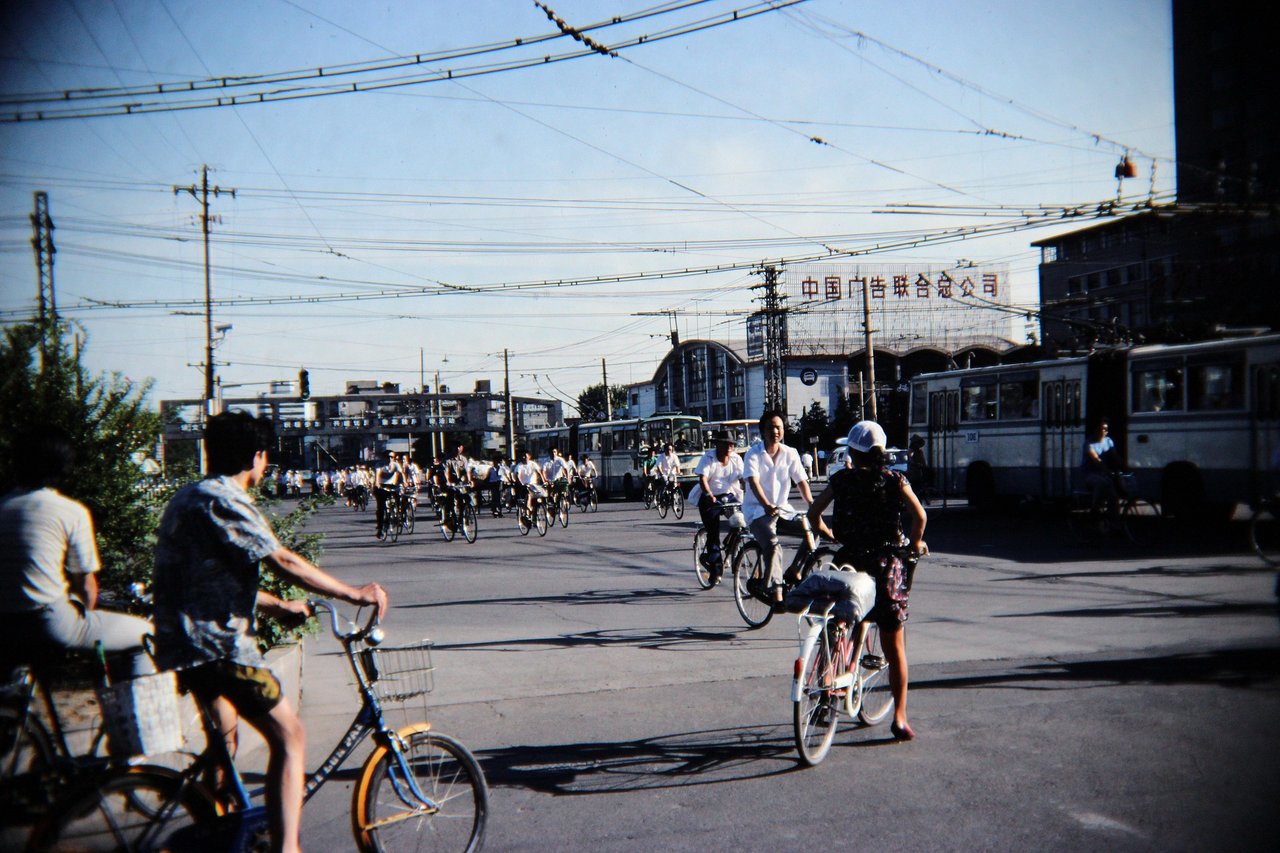
Beijing: bicycles then, cars now. [WMC]
It’s not at all surprising that we want the comforts and luxuries that our technology offers us. My cat likes a comfortable armchair and a warm radiator as much as any human does; the difference being that cats cannot manufacture armchairs and radiators, while we have learnt how.
But there is a far stronger pressure for increased consumption than just our natural desire for creature comforts. The free-market economy by its nature, drives consumption growth. Only by continually persuading people to want a bigger variety of things and more of them, can we increase the demand for products and thus sustain a reasonable level of employment, which would otherwise decline as jobs are eliminated by automation. The free market provides all the incentives needed for the invention and marketing of those new wants: businesses, the rich, and ordinary workers, are all united in seeking growth. Businesses cannot stand still but must continually innovate and cut costs because if they don’t their competitors will. The rich want to maintain and grow their wealth and guarantee their financial security. Ordinary workers want a booming economy to guarantee employment and increase wages.
Any human activity can result in damage to the environment, whatever the economic system. In antiquity, crop cultivation and livestock grazing changed the landscape, the smelting of metals generated pollution, forests were cut down for construction and fuel. The Earth charges nothing for the resources we take from it or the damage we do to it – if you are charged for a resource it is by another human who has already laid claim to it, not by our planet. Since we are charged nothing for what we do to the Earth, we humans find it fairly easy to accept damage to the environment:
Perhaps the most important of these points is the last. The logic of the free market demands “thou shall cut costs to the minimum necessary to maximise profits and avoid the risk of being undercut by a competitor”. The Earth doesn’t charge for the damage inflicted, so paying to protect it is pointless charity. There are two sorts of natural resources that businesses can exploit: resources they own and resources that are part of the global commons (like air and the oceans).
To own a resource, typically the business owns the land where it is located, examples are a mine or a farm. When the resource is owned, then there may be an incentive to protect it to some degree. If the resource is a farm there is an economic incentive to look after its soils so it continues to produce in the long term (although there is also an incentive to grub up all the hedgerows, slap on herbicides and pesticides, and maximise profit for the owners/investors in the short to medium term). However, if the resource is a mine, there is no incentive to maintain the condition of the land or restore it after mining ceases, unless the owner perceives some profitable use for it post mining.
Apart from those resources that can be privately owned, there are also resources that are part of the global commons – that is, they are owned by no-one ... or in a sense everyone. Chief among these are the atmosphere and the seas. Some rivers, lakes, and areas of land also have the status of commons. Economists speak of the ‘tragedy of the commons’, because nobody has an economic incentive to protect them. The concept is simple enough to understand. If you own pond, it is not in your interest to catch all the fish because you want some to remain for the future, and since they belong to you, it is your decision – no-one else is going to take them. But on the global commons of the open seas there is no incentive not to catch and sell the very last fish, since if you don’t, it’s likely that another fishing fleet will.
The same logic applies to damaging the global commons. Why should your factory install expensive pollution filters to clean your waste water, cutting your profit margin, if other factories don’t have to? Why should you manufacture cars that emit less climate-changing CO2 into the atmosphere if other manufacturers are not obliged to? We shall talk more about the tragedy of the commons concept in Chapter 17.
Costs imposed on society by business activity, like damage to the environment, are referred to by economists as external costs.
The production and consumption of all economic goods and services have both internal and external costs. The price a consumer pays for a car reflects the costs of the factory, raw materials, labour, marketing, shipping as well as mark up to allow a car company and its dealers to make a profit. After the car is purchased the buyer must pay for petrol, maintenance, and repair.
Direct costs that are paid by the seller and the buyer of an economic good like a car, are called internal costs. But production, distribution and consumption also involve ‘external costs’, sometimes known as social costs or the losses that are not included in the market price. Examples of these external costs or ‘externalities’, imposed on society during the manufacture of a car, include: depletion of natural resources and energy, hazardous wastes, spoilt land, air and water pollution, greenhouse gas emissions causing global warming, and reduced biodiversity.
As customers, we are complicit in this environmental damage because these harmful costs are not included in the market price of the goods that we buy. When you buy a car, neither you nor the maker pays for the damage caused by the CO2 emissions generated during its manufacture; those costs fall on society as a whole and more on some than others. When you drive a car you don’t have to pay the residents of streets you pass through, compensation for the contaminated air, tyre dust, or noise pollution, that you impose on them – nor recompense the citizens of island nations whose homes are disappearing as sea levels rise due to climate change caused by carbon emissions. But ultimately all of us will pay the price of a degraded environment, including car drivers and their descendants.
Could we get around the ‘growth damages the environment’ problem by not producing more material products and instead focussing all growth on services? For example, entertainment distributed over the internet is a service without any physical product. If services or knowledge become a ‘product’ why can’t production and consumption continue to grow but in terms of non-material goods? There are several reasons why this appears highly unlikely unless the current structure of society is radically changed:
Even the extremely rich (like the world’s twenty-six richest people who own as much as poorest half of the world [19]) are not going to employ more than a certain number of people providing services. However, what they can do is consume prodigious amounts of goods whose manufacture generates employment, and there is a world of businesses trying to come up with such goods in order to tempt the very rich to spend. Think of billionaires who have their own space programme, think luxury yachts, villas, private jets, race horses, private zoos, and insanely expensive cars, clothes and watches. Those who want influence can also spend on businesses that may run at a loss but serve for self-promotion, such as newspapers, TV stations, sports clubs and the like. In this manner the extremely rich do create some employment, but at the expense of the production of large quantities of unnecessary stuff with its accompanying resource use and environmental damage.
For an economy based on service industries to work, we would need to radically reshape the economy in a way that provided people with an income that allowed the purchase of a large variety of services, but limited the purchase of material goods both in quantity and to products that are not unduly damaging. Our existing market economy will not do that. By its nature it tends to give the workforce only the minimum materially necessary; it has no incentive to pay workers extra to be spent on services not essential for their subsistence.
One approach to tackling the problem of businesses that damage the environment, is to mount consumer campaigns to buy from ‘responsible’ companies and boycott the bad ones. This may be worth doing in order to demonstrate alternatives. For example, environmentally aware consumers may be able to kick-start an alternative, driving its price down and making it become available more widely. Organic foods are an example: once they were available only in specialist health food shops, whereas now most large supermarkets stock an organic range.
However, while there is no harm and hopefully some good in encouraging people to be responsible consumers, it seems very unlikely that trying to persuade all consumers to be ‘good’ consumers could ever solve the problems created by the uncontrolled operation of the market economy, for these reasons:
The evidence is there to see. ‘Green’ consumers have some successes, but the market has done what it does best: find more stuff to sell, whatever the market sector. So the environmentally conscious consumer has to some extent become just a target market for more unnecessary stuff that can however somehow be branded as ‘green’.
Consumer choice is also ineffective in cases where you cannot choose an alternative unless almost everyone does. An example is the private car. Not so very long ago, all roads were the preserve of pedestrians, cyclists and the occasional horse and cart. Children played in them, and the only pollution was horse-manure. When cars appeared, if you chose to buy one you gained a significant benefit in your personal mobility but made only a small difference to the total number of cars on the streets. Suppose you as a consumer, would like to return to those peaceful unpolluted streets of the past? You could scrap your car, but in return for giving up its convenience, the benefit you get is infinitesimally small: there will only be one less car on the streets. It is essentially the same scenario described as the ‘tragedy of the commons’ earlier in this chapter: roads are not part of the global commons like the oceans, but they are a shared space. Therefore, achieving quieter healthier streets requires civic action and government-imposed rules – and the same is true for many other public goods and benefits. We shall return to the tragedy of the commons concept and the example of motor traffic, in Chapter 17.
If not the consumer, who then can prevent businesses from damaging the environment? The obvious candidate is government, which can regulate to restrict or outlaw activities that cause damage. The state sets the rules under which businesses operate, and the state can set aside areas of land or sea to be protected. It is not necessarily a problem for a business to incur extra costs provided that their competitors also have to obey the same rules. State regulation provides the most effective environmental controls that we have so far managed to secure, even though they fall far short of what is needed.
Regulation is nevertheless fraught with difficulty. For one thing, the scale of the problem is continually growing because of the sheer number of products and processes technology makes possible. For another, regulation has to be applied in most or all countries; if it is not, unregulated countries can sell products more cheaply and undercut the responsible ones. Reaching international agreement on regulation is slow and difficult with business groups in each country often lobbying fiercely against, for fear that they will lose out.
As individuals our best chance of tackling the environmental crisis is as citizens, not as consumers. We can press for action at all levels of government as well as in other institutions where we have the opportunity. However, business interests also lobby government; government is not automatically the environment’s friend.
Humans are having a dramatic and catastrophic impact on the environment as a result of rapid population growth and soaring human consumption per person. The ability to grow our numbers and to produce more per capita are the result of our growing capabilities due to advances in technology. The market economy requires and incentivises growth as being necessary for the rich to get richer, the poor to keep their jobs and businesses to survive and grow. Businesses are under market pressure not to take on costs that their competitors don’t have to, such as environmental protection; government regulation is therefore required, thus maintaining a ‘level playing field’ between businesses.
A shift to a mainly service-based economy that doesn’t damage the environment because few material resources are used, is not possible for a free-market economy without government regulation – the reason being that businesses won’t pay workers much more than the minimum required for subsistence material goods, and services are for the most part inessential. Business owners and the wealthy are too few in number to consume so many services that the economy becomes service-based due to their consumption alone.
‘Ethical consumers’ may make some difference but cannot ‘save the environment’ via their shopping habits because there are too few of them and because the variety of products is too great for an ethical choice to be made or even be available in every case.
Effective measures require collective action. Action as citizens and by government are the best tools we have to increase environmental protection, though since governments are also lobbied by the polluters, there is no guarantee of success.
1“But though, in disputes with their workmen, masters must generally have the advantage, there is, however, a certain rate, below which it seems impossible to reduce, for any considerable time, the ordinary wages even of the lowest species of labour. A man must always live by his work, and his wages must at least be sufficient to maintain him.” – Wealth of Nations, Book 1, Chapter 8.[12]