All of us are familiar with our own economic activities, in so much as we know how we earn our living and how we spend what we earn. This and the following four chapters are about the bigger picture: the dynamics of the market economy, or how the whole economy functions as a system. Economists call this “macroeconomics” (as opposed to “microeconomics” which refers to players within the system: businesses and individuals). We will look at:
It is important that we as citizens gain a broad understanding of the economy as a whole, because otherwise politicians can too easily sell us policies based on what may sound like common sense, but when applied to the whole economy make no sense at all. Given how often this happens, it seems likely that there is a deliberate intention to fool us into accepting what is not in our interest.
In this chapter we look at the labour market and in particular, examine these two widely heard claims:
Will there be enough work for everyone who wants it? Many economists claim that the market will always provide jobs for all provided that it is free to operate. By that they mean: no trades unions, no government regulation setting minimum wages and no unemployment pay. Under these conditions they claim that the price of labour will adjust until the market clears, i.e. wages will fall until everyone gets a job. Sadly this claim is simply a lie, however much it is dressed up in economics mumbo jumbo.
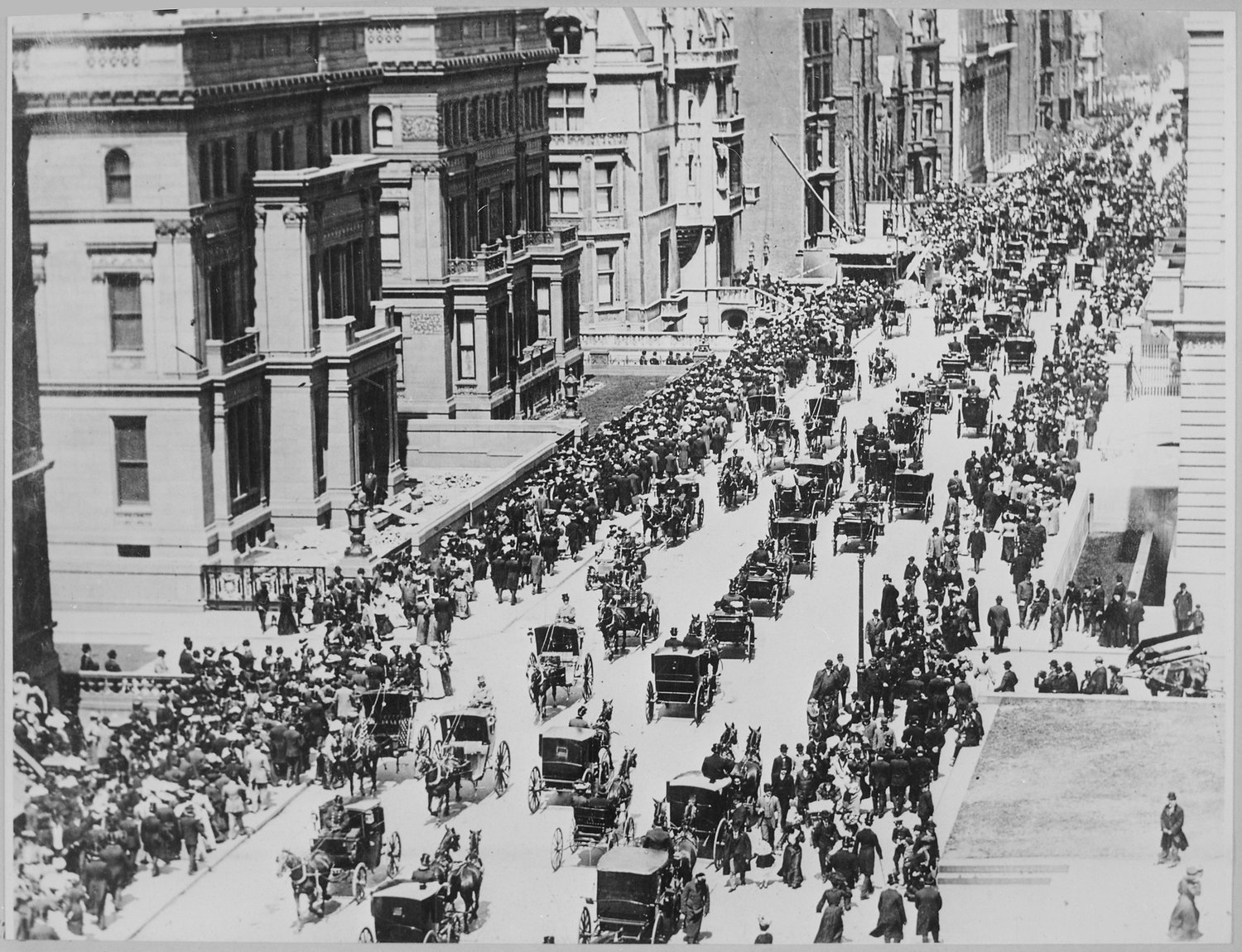
The harsh truth is that there is no guarantee that a market economy will offer jobs to all. Until the 20th century there were thousands of horses in our cities. These animal workers were wanted for their strength to pull carts and carriages and their intelligence that enabled them to learn to do the work and respond to commands. In exchange, they received their food, stabling and grooming. The development of the internal combustion engine and motor vehicles took away almost all of their work. You would have seen thousands of unemployed horses standing around on street corners if it were not for the fact that humans control the reproduction of horses and don’t breed them if there is no demand for them.
Human workers, like the horses, have frequently been displaced by technical development. Until the industrial age, most jobs required physical strength and stamina; nowadays, much work is mental. The manual work that remains is typically a combination of dexterity and intelligence such as building products on an assembly line. And slowly these jobs too are being replaced by robots. But unlike horses, human workers are not bred only when there is a demand for us. We are able to choose for ourselves to have children; there are a multitude of factors affecting how many children we have, and it’s probably safe to say that a careful and accurate assessment of whether our babies will have jobs to go to when they grow up, is not usually one of them. Accordingly, there is no guarantee whatsoever that the number of jobs available will match the number of people seeking work.
“Aha”, say our free-market economists, “people will always find work if they accept ‘realistic’ (i.e. low enough) wages”. But while this claim may sound reasonable, given a moment’s thought it is plainly false: even if the price of something falls to zero, we do not want any amount of it. I pay the water company to pipe water to my home; but if water became free I would not then appreciate an entire reservoir being dumped on my house and garden – I’d call that a flood and pay to have it pumped away.
An excess of anything ceases to be a benefit and becomes a nuisance. So it is with humans. Expatriates working in poor countries who receive European or US level salaries, often employ two or three local people to help with housework or childcare. In those countries local salaries for such workers can be as low as $50 a month, so expatriates could easily hire not just two or three servants, but fifty or more. Why don’t they? The reason is simple, there is not enough work for them - and you positively don’t want dozens of strangers hanging around your house eyeing up your possessions and watching your every move. If they offered to work for free you still wouldn’t want them; if they still insisted on hanging around, you’d pay a guard or policeman to keep them off your property.
The belief that the labour market should always clear, provided that it is left alone, leads its adherents to propose the elimination of all restrictions on the labour market such as minimum wage schemes, unemployment pay and other worker rights and benefits, as the way to reduce unemployment. Their theories are used to justify policies that minimise workers rights. The resulting poverty and continuing unemployment tends to be blamed on any remaining rights that the workers have managed to keep and on any actions workers take to defend themselves such as organising trades unions.
Even critics of the market clearing theory often appear to say that it would work in an ideal world, and doesn’t work in practice only because the assumption of perfect competition is not fully met in the real world. Given the political influence of the theory, that is not good enough; we shall demonstrate that the theory is not just imperfect, but wrong.
So far in this chapter we have discussed in a general way why there is no guarantee that a labour market will clear. To conclude the chapter we will lay out those reasons as clearly as possible; there are three:
These three points are discussed at greater length below.
It is not true that any amount of any product can be sold if the price is low enough. If the price of tomatoes drops you might buy more but if it dropped to one dollar a ton you would not buy several tons of them to pile up in your kitchen. Beyond a certain quantity, a product ceases to be desirable and becomes instead a problem, and this is equally true of labour. A wealthy person in a poor country may be able to employ hundreds of servants at a wage of a couple of dollars a day. But hundreds of people in your home are even more unwelcome than a ton of tomatoes: they might break furniture, steal, or even take over the house. So in practice a rich person will only employ as many people as he or she has useful work for and can manage. Incidentally, a wealthy person may well choose to pay the servants that he or she does employ, a higher wage than the absolute minimum necessary, because it is worth doing so in order to elicit loyalty and reduce the need or desire to steal.
Sellers will not sell at any price however low because there are usually some costs involved in selling (e.g. transport to market). There is no point in selling at a price that is below these costs since the outcome will be a net loss. In the same way, workers will not accept less than some minimum wage because they need to cover the additional (marginal) costs of working such as travel to work, wear and tear on clothes, extra food needed, and to make it worth their while to work rather than just beg or look through garbage for something to eat.
The reason that the markets in most products generally do clear is that if they don’t, the producers stop making them. When the supply of cars exceeds demand, prices drop. When prices drop below the cost of production of some of the producers, then those producers reduce production or go out of business. Either way cars are not produced if they cannot be sold at more than the cost of production. It could be argued that this is a bad analogy because workers are not ‘sold’ but rent out their time to employers for wages. However, this makes little difference: the same thing would happen even if all cars manufactured were rented to consumers instead of being sold - if you couldn’t rent them you would cut production. The end result would still be the same regardless of whether the cars were rented by the manufacturer or a separate car rental company. You certainly wouldn’t say that the cars that couldn’t be rented were no longer producing car-hours and thus hey presto the car market has cleared because only the car-hours that actually were sold are counted as having been produced.
Now let’s look at how this applies to the labour market. Some economists attempt to defend the market-clearing theory by saying that instead of the workers themselves being sold (rented out), the workers produce a product called ‘labour-hours’ which they sell on the labour market; if they cannot sell their labour-hours at a price that is acceptable to them, they withdraw from the market and cease to produce labour-hours. But this argument twists reality. In fact the product is not labour hours but the workers themselves, though since slavery was abolished they may only be rented by the hour to employers, not sold to them. A worker cannot cut his or her contribution to the total number of workers that would like to sell their labour, because he or she has already been ‘produced’. Workers also incur fixed ‘maintenance’ costs (food, housing, clothes, etc.) regardless of whether they sell their labour or not.
If for some reason too much of a product is produced, the lowest price that the producer will sell at is the extra cost of selling it as opposed to just disposing of it. For example, from time to time farmers do produce surpluses that cannot be sold at a price that makes it worthwhile taking them to market. They then may choose to dump the products without ever having offered them for sale. Likewise, workers who can see no prospect of a job, may ‘dump’ their surplus labour-hours by not actively offering themselves for work. No one would argue that since surplus tomatoes had never been offered for sale, they had actually not been produced. In the same way, it should not be argued that those workers who do not try to sell their labour, are not really workers.
To turn the workers themselves into commodities, produced according to the quantity demanded by the market, we would have to treat them (i.e. treat ourselves) like we do farm animals. Over the last century the demand for horses declined as they were replaced by trains, tractors and cars – yet there is no over supply of horses because they are ‘produced’ (bred) to meet market demand. If an oversupply occurs, fewer are bred and some may also be slaughtered to correct it.
Humans however are not farmed. Instead, we make personal choices about how many children to have, influenced by many factors (including of course the availability of birth control). Parents decide (if the pregnancy was planned at all!) to ‘produce’ new workers without first calculating their expected saleability on the labour market between 18 and 65 years in the future. Thus the supply of workers cannot be expected to adjust itself to make the labour market clear: there is likely to be a surplus or shortage.
Summary of the labour-hours argument.
The labour-hours argument is the most obscure of the
attempts to justify market clearing. The key point is that some
economists1
see individual workers as autonomous manufacturers of the labour-hours
‘product’, who, if they are unable to sell their product, should jolly well
cease to produce it, just as a manufacturer of widgets would in the same
circumstances, and then find something else to sell. But workers
themselves are the ‘product’ that is being sold on the labour market
– sold by rental per hour, or ‘wage’. They have already been
‘produced’ and typically they don’t have anything else to sell. At
most, they have some minimal personal possessions which once sold
would leave them with nowhere to live and no clothes. The idea of
workers as ‘producers of labour-hours’ appears to be little more than
desperate mental gymnastics to try to justify existing economic
theory.
It is interesting to note that in the capitalist world people are increasingly referred to as commodities. The ‘personnel departments’ of the 20th century have changed their name to ‘human resources’ and project planners refer to ‘how much resource’ they need instead of ‘how many people’. While it may not be much good at solving unemployment, economic theory has quite successfully influenced the way we think.
There is no reason to suppose that the labour market will clear because at any given time the supply of labour is relatively fixed and unrelated to demand: it is the population of working age who need to work in order to live. Therefore, if labour demand exceeds supply, wages are good. If demand is less than supply, and remains so even if workers accept the lowest wage at which they could just cover their costs of working, then there will be unemployment.
Reflecting on the millions of people under-employed or unemployed around the world, it is easy to see that currently at the beginning of the 21st century, labour supply exceeds demand (with some local or special exceptions). This conclusion is perfectly in keeping with our wants, resources, work-effort model: there will be a surplus of unused work-effort if one of the other ingredients runs out first.
Because of the importance of this topic in setting government policies, we continue with it in Chapter 8 where we examine the classical Supply-Demand diagram used by some economists to argue that left to itself, the labour market will provide full employment and the best outcome for both labour and businesses. Following that in Chapter 9 we will consider why demand for labour is maintained to the degree that it is.
1Those of the ‘New Classical Economics’ school of thought, I believe.